Lanterns at the Gatehouse: A Chauffeured Case for Winter Castle Stays
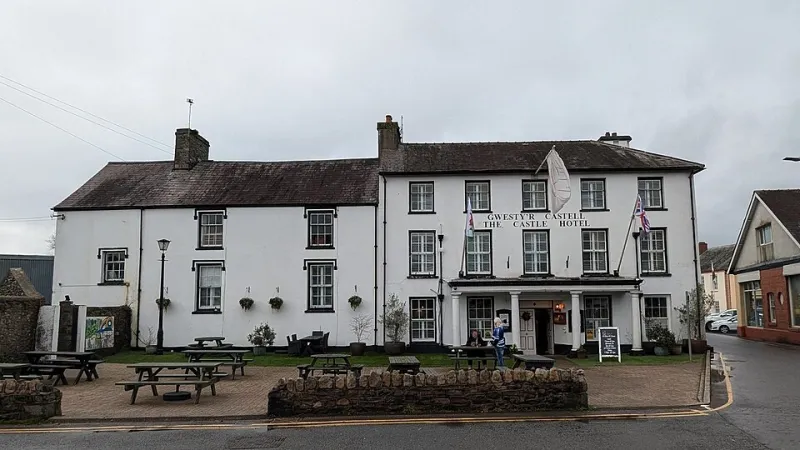
Photo: Sandy Gerrard , CC BY-SA 2.0, via Wikimedia Commons
There is a particular moment, somewhere between the last village and the first set of gateposts, when a winter castle stay begins. The headlights pick out a wall, then a lodge, then a sweep of gravel that seems to go on longer than it reasonably should. Nothing about that approach is difficult in itself — but after four o'clock in December, on an unlit single-track lane with a deer fence on one side and a ditch on the other, it is not the moment to be negotiating a hire car and an unfamiliar satnav.
That, in essence, is the argument for arriving by chauffeur. Not because a castle hotel requires a grand entrance, but because the last twenty minutes of the journey are the ones most likely to undo the good work of the first two hours.
Why the Winter Version Is Different
Britain's castle hotels — Thornbury in Gloucestershire, Langley in Northumberland, Amberley in West Sussex, Bovey in Devon, Inverlochy and Glenapp further north — are, almost without exception, reached by roads that were laid out for horses and carts rather than for anything with a boot full of luggage. In summer this is charming. In winter it is simply dark.
Sunset in the second week of December falls before four o'clock across most of the country. Add a wet surface, a low sun that never quite clears the hedgerows, and the occasional patch of standing water at the bottom of a dip, and the case for a professional driver makes itself. The rear cabin, meanwhile, offers something the driver's seat cannot: a chance to arrive already composed, coat on, reservation confirmed, and with the first glass of something waiting rather than the last mile still to be driven.
Planning the Arrival, Not Just the Stay
Most castle hotels set check-in from three o'clock, with dinner typically served between half past six and nine. That leaves a comfortable window, but it is worth building the day backwards from dinner rather than forwards from departure.
A sensible pattern for a two-night stay from London or the Home Counties looks like this: a mid-afternoon collection, arriving shortly before dusk so that the approach is made in the last of the light; luggage taken up while the room is settled; an hour for a bath or a walk to the walled garden; dinner at half past seven. Guests travelling from Manchester or Edinburgh can often manage the same shape with a slightly earlier start.
Where the hotel offers a gatehouse or lodge entrance, ask in advance which one the driver should use. Several properties have more than one approach, and the one signposted for daytime visitors is not always the one that leads to the main door after dark.
The Practicalities That Rarely Get Written Down
A few details are worth confirming with the hotel when the booking is made, and passing to the chauffeur in writing.
- Surface and turning circle. Gravel, cobbles and cattle grids all appear on castle driveways. A larger vehicle may need to set down at the door and park elsewhere; knowing this in advance avoids an awkward manoeuvre in front of the log fire.
- Height and width restrictions. Archways, low bridges and narrow gatehouses are genuine constraints at several older properties.
- Luggage handling. Many castles have no lift to the upper floors, and porters finish at a set hour. Arriving after nine o'clock with four suitcases and a staircase is a poor introduction to a romantic weekend.
- Dress codes. Some dining rooms still ask for a jacket at dinner. A garment bag left in the car until it is needed is a small courtesy that saves a change of plan.
Narrow Lanes, Winter Light and the Question of Timing
There is a temptation, when booking a castle break, to schedule the day tightly — a garden visit, a market town, perhaps a distillery or a cathedral — and then to drive oneself between them. In winter this rarely delivers what was imagined. Daylight is short, attractions close early, and the pleasure of a short break lies in not spending it in a car park reading a map on a phone.
A better arrangement is to treat the chauffeur as a fixed point within the day rather than a continuous presence. A morning transfer into the nearest town, a collection after lunch, and a car waiting at the door at half past six is usually sufficient. It leaves the middle of the day unstructured, which is precisely the point of going away in February.
Should the weather turn — and in a British winter it may — the plan can be adjusted without penalty. Fog on the Moors, snow on the A9, a fallen branch on a Devon lane: these are the reasons a local driver with a phone and a knowledge of the alternative route is worth more than the sum of the fare.
The Morning After, and the Road Home
Departures deserve as much thought as arrivals. Castle hotels tend to serve breakfast until half past nine or ten, and check-out follows shortly afterwards. A car booked for eleven o'clock allows for a leisurely final morning without the anxiety of a queue at the door.
For those returning to London, the route home can usefully include a stop: a market town for lunch, a National Trust garden with winter interest, or a farm shop worth the detour. It turns a two-hour drive into a pleasant half-day, and it means the weekend does not end abruptly at the front gate.
For guests continuing to an airport or a station, the same logic applies. A direct transfer from a castle driveway to a terminal, with luggage already accounted for, removes the one genuinely tiresome part of any short break.
A Considered Kind of Romance
The appeal of a winter castle stay is not difficult to understand: fires, four-posters, long corridors, the sense of having stepped briefly out of the present. What is harder to arrange is the seamlessness that makes such a weekend feel effortless rather than merely expensive.
That seamlessness is mostly a matter of detail — the gate chosen, the hour fixed, the luggage anticipated, the drive home not rushed. A chauffeur does not make a castle more romantic. He simply ensures that nothing about getting there interferes with it.