The First and Last Hour: Chauffeur Logic for London's Airports in 2026

Photo: Miguel Discart, CC BY-SA 2.0, via Wikimedia Commons
Ask frequent travellers what they remember about a business trip and they will rarely describe the flight. They will describe the twenty minutes spent circling a terminal forecourt, the taxi queue at half past eleven at night, or the moment a bag went missing between the carousel and the kerb. The aviation is usually the least memorable part.
That is the case for a chauffeured transfer, and it is a practical one rather than a decorative one. What follows is a working guide to London's three principal airports in 2026 — how to choose the right one, how to build realistic timings, and how to avoid the friction points that catch out even experienced travellers.
Choosing the terminal, not just the airport
London's airports are not interchangeable, and neither are their terminals. Heathrow's five terminals serve different airline groupings, and confusion here is the single most common cause of a missed pickup. Terminal 5 handles the bulk of British Airways traffic; Terminal 2 is the principal Star Alliance base; Terminals 3 and 4 serve a shifting roster of carriers. Always confirm the terminal on the booking rather than the airport alone, and check again forty-eight hours before departure, because airline allocations do move.
Gatwick splits between North and South terminals, with the inter-terminal shuttle adding a useful ten to fifteen minutes if you arrive at the wrong side. London City, in the Royal Docks, is a different proposition altogether: compact, quick and close to Canary Wharf and the City, with a short check-in process that rewards travellers who arrive as instructed rather than hours early.
Building an honest arrival time
A pickup time is not the same as a landing time. For a long-haul arrival into Heathrow, allow forty-five to sixty minutes from touchdown to the arrivals hall under normal conditions — longer at peak periods, longer still for passengers who are not UK or EU passport holders, and longer again if hold baggage is checked through from a connecting flight.
For domestic and short-haul arrivals without checked bags, twenty to thirty minutes is often realistic. The point is that these are estimates, not promises. A chauffeur tracking the flight will adjust automatically, and a good operator builds in a grace period after landing as standard rather than as an extra.
Meet and greet, plainly explained
There are two ways to be collected. The kerbside pickup is simpler and cheaper: the vehicle arrives once you are standing outside with your bags. The meet-and-greet places the chauffeur inside the arrivals hall with a name board, assisting with luggage and walking you to the car. For anyone arriving after a long flight, with children, with heavy or multiple bags, or in an unfamiliar terminal, the second is worth the modest difference in cost.
Specify which you want when booking. It is also worth confirming how the chauffeur will contact you — a mobile number that works on arrival in the UK saves considerable time.
Departures are their own discipline
On the outward leg, the calculation is reversed. Terminal drop-off levies at Heathrow and Gatwick mean vehicles cannot linger, and forecourt congestion can add ten minutes even when everything else runs smoothly. A sensible rule is to arrive at the terminal two hours before a short-haul departure and three before a long-haul one, with a further thirty minutes added if you are travelling with family or checking in multiple bags.
Allow extra road time for the M25, the M4 and the approach roads to London City, and check for engineering works and events at Wembley or the ExCeL that may coincide with your journey. A chauffeur will build this in; a taxi summoned at short notice will not.
Luggage, vehicles and the details that decide the car
Be specific about luggage. One large suitcase per passenger is a different vehicle from three, and golf clubs, skis, pushchairs and instrument cases each change the requirement. Child seats and booster cushions should be requested in advance and confirmed, not assumed.
If you are travelling with colleagues, say so, and confirm the seating layout rather than the headline passenger count. A comfortable four is not the same as a comfortable four with six suitcases.
The friction points worth knowing
Flight diversions and terminal changes are the classic disruptor: a plane lands at the wrong Heathrow terminal and the waiting car is two miles away. Confirm that your operator monitors the flight number rather than relying on your stated time. Rail engineering works push more travellers onto the roads and lengthen transfer times appreciably. Industrial action at an airport can alter everything from bag drop to the arrivals flow.
The solution is not anxiety but information. Give the operator your flight number, a mobile number that will be live on arrival, and permission to be contacted through a second channel if the first fails.
Discretion, and why it matters to corporate clients
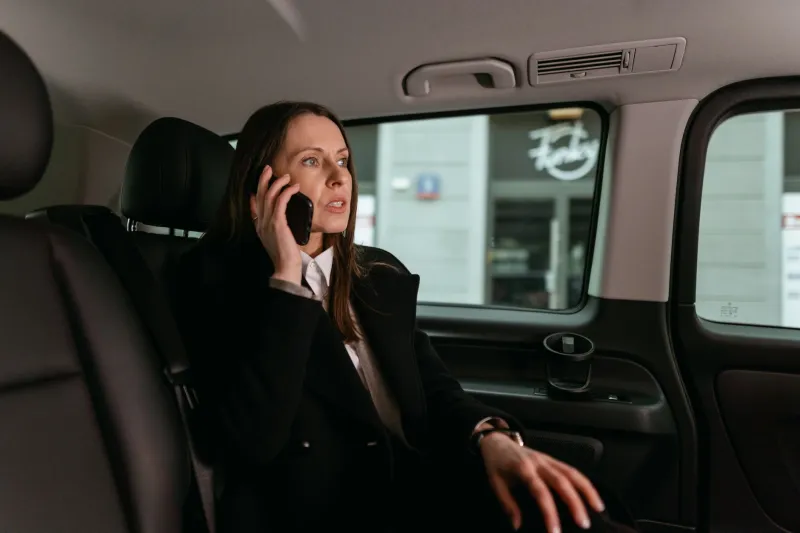
For those travelling on business, a chauffeured car offers something a ride-hailing app cannot: a known driver, a fixed price agreed in advance, a vehicle of consistent standard and a conversation that goes no further than the journey requires. Documents can be read, calls taken, and a presentation rehearsed in the rear cabin. Operators accustomed to corporate work will understand confidentiality without needing it spelled out.
The cost argument, fairly put
A chauffeured transfer is rarely the cheapest line item on a travel booking. It is, however, predictable — a fixed price, no surge, no meter idling in traffic, and no additional charge for the fifteen minutes lost to a closed slip road. Measured against short-stay parking at a London airport, or against the cost of a missed flight, the arithmetic is less one-sided than it first appears.
The quiet standard
The test of a good airport transfer is that you barely notice it. The car is there. The bags are dealt with. The route is sensible. The first hour of the trip is spent thinking about the meeting ahead, or the holiday beginning, or nothing at all — and the last hour, coming home, ends at your own door rather than at the back of a queue.